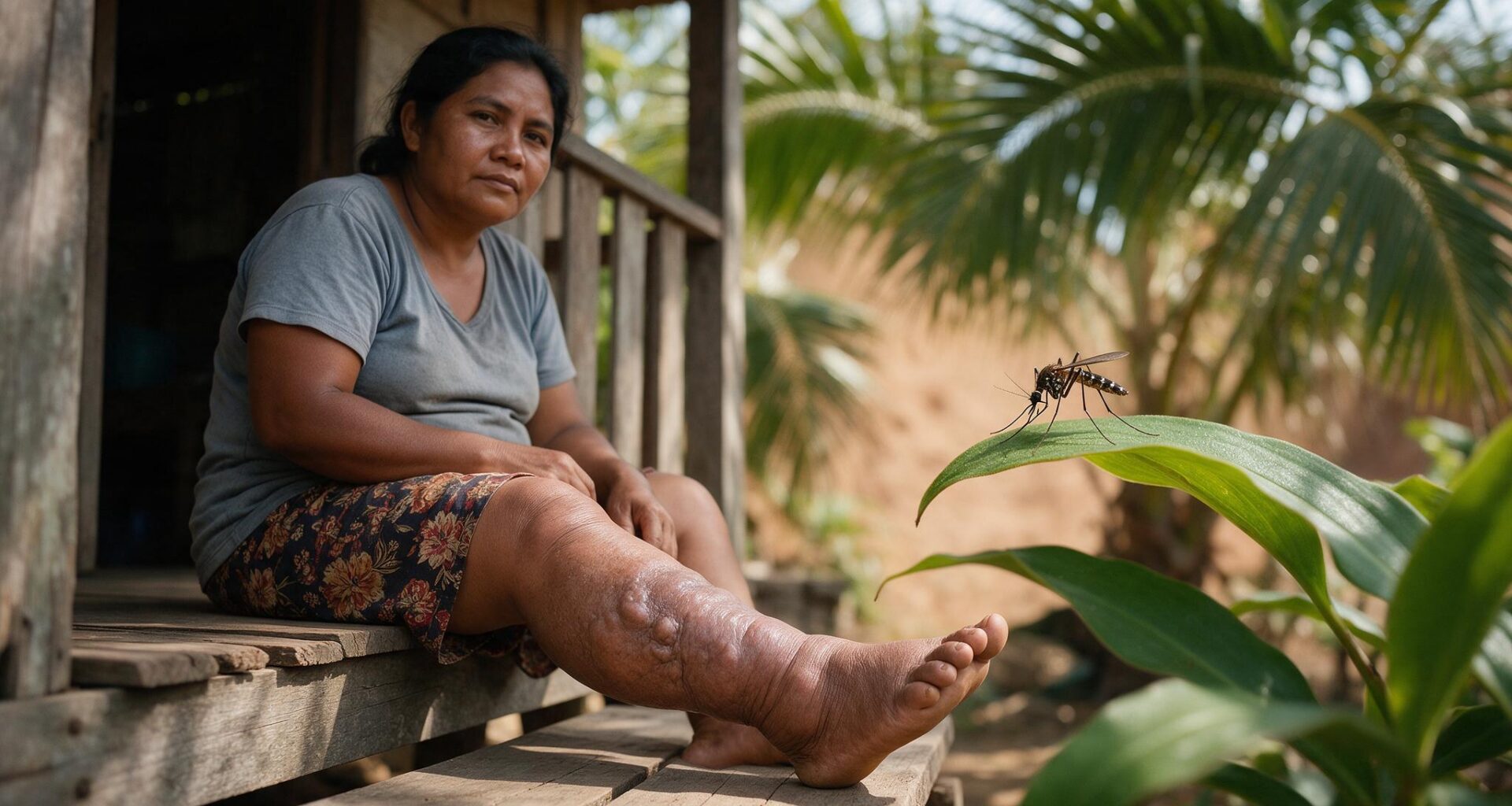
Lymphatic filariasis is a parasitic disease spread by mosquitoes that damages the lymphatic system, the network of vessels and nodes that helps the body balance fluids and fight infection. Left untreated, it can cause lifelong swelling, pain, and disability, and the condition has long been known by its most visible outcome, elephantiasis.
Most people who carry the parasites feel fine for years, which makes the disease easy to overlook until damage is done. This article explains what lymphatic filariasis is, how it spreads, who faces the greatest risk, and how it is diagnosed, treated, and prevented. It also looks at the worldwide effort to end it.
The disease is closely tied to poverty, and its effects reach beyond physical health. Swollen limbs and genital changes often bring stigma, lost income, and isolation, so understanding the condition matters for patients, families, and communities alike.
What Is Lymphatic Filariasis?
Lymphatic filariasis is a neglected tropical disease caused by thread-like parasitic worms that live in the human lymphatic system. The World Health Organization describes it as a condition that can lead to abnormal enlargement of body parts, severe pain, and lasting disability, along with social stigma and financial hardship.
The term elephantiasis refers to the advanced stage of the disease, when chronic lymph blockage causes extreme swelling and thickening of the skin, most often in the legs. Not everyone with lymphatic filariasis develops elephantiasis. Many people harbor the parasites without ever showing outward signs, while others progress to severe disease over many years.
The disease is not contagious through casual contact. It cannot spread by touching, hugging, or sharing food with an infected person. Transmission requires a mosquito to carry immature parasites from one person to another.
The WHO reports that about 657 million people in 39 countries were living in areas needing preventive treatment in 2023, and that an estimated 51 million people were infected as of 2018. These figures come from older WHO reporting and have been declining as control programs expand.
What Causes Lymphatic Filariasis and How It Spreads
Lymphatic filariasis is caused by three species of parasitic worms. Wuchereria bancrofti is responsible for roughly 90 percent of cases worldwide. Brugia malayi accounts for most of the remainder, and Brugia timori causes disease in a limited number of islands in Indonesia and nearby regions.
These worms belong to a group of roundworms called filarial worms. As the Centers for Disease Control and Prevention explains, the adult worms live in the lymphatic vessels, where they can survive for years and cause progressive damage.
The Life Cycle of the Parasite
The cycle begins when an infected mosquito bites a person and deposits infective larvae on the skin. The larvae enter the body through the bite wound and travel to the lymphatic vessels, where they grow into adult worms over about six to twelve months.
Adult female worms then release millions of tiny larvae called microfilariae into the bloodstream. In many regions these microfilariae circulate mainly at night, which matches the biting habits of the local mosquitoes. A mosquito that feeds on an infected person swallows the microfilariae, the parasites mature inside the insect, and the cycle repeats with the next bite.
Mosquitoes That Spread the Disease
Several mosquito genera carry the parasites, depending on the region. Culex mosquitoes are the main carriers in many urban and semi-urban areas, Anopheles mosquitoes transmit the disease in much of rural Africa, and Aedes mosquitoes are common vectors in Pacific islands. Because transmission needs repeated mosquito bites over months or years, short visits to affected areas carry a very low risk.
Key Insight: A single mosquito bite rarely causes lymphatic filariasis. Infection usually develops after many bites over a long period, which is why the disease clusters in communities where mosquitoes are abundant and prevention is hard to maintain.
Who Is at Risk of Lymphatic Filariasis
The disease occurs in tropical and subtropical regions of Africa, Asia, the Western Pacific, and parts of the Americas. People who live in or spend long periods in these areas, especially where sanitation is poor and mosquito breeding sites are plentiful, face the highest risk.
Poverty is a major driver. Crowded housing, standing water, and limited access to bed nets and health services all raise exposure. The disease also tends to be acquired in childhood, even though the visible effects may not appear until adulthood.
Travelers rarely develop the disease. The Merck Manual notes that travelers are at low risk because infection typically requires prolonged, repeated exposure to infected mosquitoes. Long-term residents, aid workers, and others who stay in endemic areas for extended periods have a higher chance of becoming infected.
| Risk Factor | Why It Matters |
|---|---|
| Living in an endemic region | Frequent exposure to infected mosquitoes over years |
| Poor sanitation and standing water | More mosquito breeding sites near homes |
| Lack of bed nets or screens | Greater exposure to bites during sleeping hours |
| Limited access to health care | Infections go untreated and progress to chronic disease |
| Long-term stay in affected areas | Cumulative exposure raises infection risk for visitors |
Signs and Symptoms of Lymphatic Filariasis
Many people infected with the parasites have no symptoms at all, even though the worms may already be harming the lymphatic system. The WHO notes that this hidden damage can occur during childhood and that symptoms can take years to emerge.
Acute Episodes
Some people experience sudden attacks of fever, chills, pain, and swelling, often with redness and warmth in a limb or the groin. These attacks, sometimes called acute adenolymphangitis, usually result from secondary bacterial infections in skin that has been weakened by lymph damage. Episodes can last several days and often recur.
Chronic Symptoms
Long-term disease produces more visible and lasting changes. These include:
- Lymphedema: persistent swelling of the arms, legs, breasts, or genitals caused by fluid that cannot drain.
- Elephantiasis: severe lymphedema with thickened, hardened, and sometimes wart-like skin.
- Hydrocele: fluid collecting around the testicle, which causes painful swelling in men.
- Chyluria: milky-white urine caused by lymph fluid leaking into the urinary tract.
The physical changes often bring emotional harm as well. Visible swelling and mobility problems can lead to shame, social exclusion, and difficulty working, which deepens the economic burden on families already living with limited resources.
How Lymphatic Filariasis Is Diagnosed
The traditional method is a blood test that looks for microfilariae under a microscope. Because the parasites in many regions circulate mainly at night, blood is often collected between about 10 p.m. and 2 a.m. so that it reflects peak parasite levels.
Other tests detect parasite proteins, called antigens, or the body’s antibody response. According to the CDC’s clinical guidance, antigen tests can be done at any time of day, which makes them far more practical than the night blood draw. Ultrasound can sometimes reveal living adult worms moving in the lymphatic vessels, a finding sometimes called the filarial dance sign.
Researchers are also working on faster point-of-care tools, as described in a recent review of point-of-care diagnostics for filariasis. Better tests are important because elimination programs depend on finding where transmission continues.
Diagnosis can be harder in people with only chronic swelling, since the original infection may have cleared years earlier and blood tests may then return negative. In these cases a doctor relies on symptoms, travel and residence history, and the exclusion of other causes of swelling.
Lymphatic Filariasis Treatment and Managing Lymphedema
Treatment has two goals: to kill the parasites and to manage the damage they have already caused. Both matter, because drugs alone cannot reverse established swelling.
Medicines That Kill the Parasites
Several antiparasitic drugs are used, often in combination. The WHO fact sheet lists albendazole with ivermectin or diethylcarbamazine citrate as standard options, and the triple-drug combination of ivermectin, diethylcarbamazine, and albendazole is now recommended in suitable settings. The CDC notes that diethylcarbamazine is the drug of choice for individual patients, while a related medicine, doxycycline, can help by weakening the worms, which depend on bacteria living inside them.
These drugs mainly kill the microfilariae and can shorten the adult worms’ lifespan, which reduces transmission and slows damage. Treatment decisions should be made by a qualified health care provider, since dosing depends on the person’s age, location, and other infections.
Managing Lymphedema and Skin Care
Caring for swollen limbs is central to reducing pain and preventing complications. The WHO’s questions and answers describe a basic hygiene-based approach, which includes:
- Washing the affected limb daily with soap and clean water.
- Drying carefully, especially between the toes and in skin folds.
- Applying antiseptic or antibiotic cream to any cuts or sores.
- Elevating the limb to help fluid drain.
- Exercising gently to encourage lymph flow.
- Wearing comfortable footwear to protect the skin.
Consistent daily care can stop the repeated infections that worsen swelling, and many patients see real improvement over time. In men, surgery can repair a hydrocele and often brings lasting relief.
Pro Tip: Prompt treatment of even small cuts or fungal infections between the toes helps prevent the bacterial attacks that make lymphedema worse. Simple daily hygiene is one of the most effective tools available.
How to Prevent Lymphatic Filariasis
Because the disease spreads through mosquito bites, prevention comes down to reducing both infection in people and contact with mosquitoes. At the community level, the main strategy is mass drug administration, in which entire at-risk populations receive medicine once a year, whether or not they show symptoms. This clears microfilariae from the blood, so mosquitoes no longer pick them up, and transmission falls.
Individuals can also protect themselves by limiting mosquito exposure. Useful measures include:
- Sleeping under insecticide-treated bed nets.
- Using window and door screens where possible.
- Applying insect repellent and wearing long sleeves at dusk and night.
- Removing standing water around homes where mosquitoes breed.
Vector control, such as insecticide spraying and bed net distribution, supports drug treatment and also helps against other mosquito-borne diseases. There is currently no vaccine against lymphatic filariasis, so preventive medicine and mosquito control remain the foundation of protection.
Global Efforts to Eliminate Lymphatic Filariasis
Lymphatic filariasis is one of the diseases targeted for elimination as a public health problem. The WHO launched the Global Programme to Eliminate Lymphatic Filariasis in 2000, built on two pillars: stopping transmission through mass drug administration, and relieving suffering through morbidity management and disability prevention.
Progress has been substantial. Several countries have been validated as having eliminated the disease as a public health problem, and the number of people needing preventive treatment has fallen steadily. The Carter Center and other partners have supported national programs, while pharmaceutical donations have supplied the medicines. A roadmap toward elimination by 2030 outlines the remaining steps and challenges.
National programs continue to advance. WHO Nepal, for example, has described the country’s push to eliminate lymphatic filariasis by 2030, supported by newer treatment approaches. Research on the current perspectives on mass drug administration shows that high participation rates are essential to success.
Challenges remain, including reaching remote communities, maintaining drug coverage over several years, and caring for people who already live with chronic disease. Even where transmission stops, patients with lymphedema and hydrocele still need long-term support, which is why morbidity management stays a core part of the global response.
Key Takeaways
Lymphatic filariasis is a preventable and treatable mosquito-borne disease that can cause severe swelling and lifelong disability when ignored. Early detection, annual preventive medicine in affected areas, mosquito control, and careful daily skin care all reduce its harm. Anyone concerned about symptoms or exposure should speak with a qualified health care provider.
Important Note: This article is for informational purposes only and is not a substitute for professional medical advice, diagnosis, or treatment. Consult a qualified health care provider about any health concern.
